
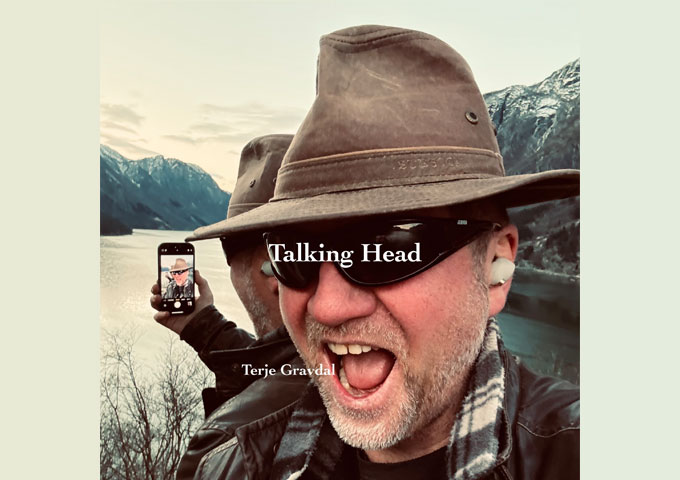
Terje Gravdal – “Talking Head”: A Folk-Country Mirror Held Up to a Noisy World
With “Talking Head”, Norwegian singer-songwriter Terje Gravdal returns not merely with a new single, but with a philosophical spark that cuts straight through the modern fog of noise, certainty, and one-way communication. Serving as the opening statement of a trilogy of country and folk releases, the song also marks the first step toward his fifth EP, “Beautiful Lies”, scheduled for release in 2026. It is a bold and reflective reintroduction that confirms Gravdal’s growing reputation as a songwriter unafraid to challenge both himself and his listeners.
Following the momentum built by “No Broken Adult”, “Apple Cider Country”, “Nomadic Grey Spirits”, “One Foot”, and “The Dreamer”, Gravdal sharpens his focus here. Where earlier songs explored identity, restlessness, and inner repair, “Talking Head” interrogates something even more pervasive: the human tendency to speak without listening, to perform thought rather than experience life.
At its core, “Talking Head” is a meditation on disconnection. Gravdal frames the song around the idea of relentless inner monologue, the constant sub-vocal chatter that keeps people locked inside their own interpretations. The lyrics describe a state where talking becomes a barrier rather than a bridge. Communication collapses into repetition. Thought loops endlessly, and the outside world fades into abstraction. Gravdal never needs to point fingers explicitly, yet the parallels to political discourse, ideological rigidity, and social echo chambers are unmistakable.
The song’s critique of “one view opinion” thinking feels especially pointed. Gravdal draws attention to how power structures, particularly political ones, often reward obedience over curiosity. When ideology replaces experience and party lines replace lived contact with grassroots reality, conversation turns competitive. Dialogue becomes a performance rather than an exchange. In this sense, “Talking Head” functions as both personal reflection and cultural diagnosis.
What elevates the song is its refusal to settle for cynicism. Gravdal does not simply expose the problem. He proposes a path forward, one rooted in sensing rather than asserting. Throughout the song, listening is framed as an act of courage. To stop talking, even briefly, is to risk uncertainty. Yet it is only through that pause that one can reconnect with the unspeakable textures of life: sounds, colors, smells, and the subtle intelligence of direct experience. Gravdal suggests that true awareness begins when thought loosens its grip.
The chorus captures this tension beautifully. The idea of a private inner presentation, a constant rehearsal of the self, is contrasted with the invitation to open the gate to communication. It is a simple image, but a powerful one. Gates can be opened or closed. They imply choice, responsibility, and intention. Gravdal asks the listener not to demolish structure entirely, but to widen it, allowing for broader representation and genuine exchange.
Perhaps the most striking moment arrives in the bridge, where Gravdal introduces a deliberately provocative line about fire, liberation, and the breaking of borders. On the surface, it sounds like a call to radical freedom. Yet Gravdal complicates this notion by acknowledging its danger. Liberation without order, without discipline or a flexible framework, becomes destructive. It is too strong a current for a single wire. This nuance separates “Talking Head” from simplistic protest songs. Gravdal understands that balance is essential. Fire must exist alongside water. Freedom must coexist with form.
Musically, the song is grounded in warm, organic country-folk textures that suit its contemplative nature. Produced and recorded at The Norwegian Sound Studio in Mjøndalen by David Michelsen and Marius Bergseth, the arrangement favors clarity over excess. Acoustic instrumentation breathes naturally, leaving space for the message to unfold. Michelsen and Bergseth not only handle production and instrumentation but also contribute to songwriting and backing vocals, resulting in a cohesive and deeply intuitive soundscape. The mastering by Peter Michelsen ensures the track retains intimacy without sacrificing presence.
Gravdal’s vocal delivery is understated yet resolute. He sings not as a preacher, but as a fellow traveler who has wrestled with the same mental noise he describes. That authenticity is no accident. Long before picking up a guitar, Gravdal spent the early 1990s writing poems that remained unpublished for decades. His late entry into music is part of what makes his voice so distinctive. He brings a lifetime of observation, reflection, and lived contradiction into every line.
That journey is remarkable in itself. In 2011, at the age of 47, Terje Gravdal bought his first guitar. Five years later, he wrote his first five songs. His debut release, “Welcome to the Rehab”, arrived on November 25th, 2022, marking the beginning of an unexpectedly prolific chapter. Since then, his partnership with Michelsen and Bergseth has proven essential, translating Gravdal’s philosophical instincts into songs that feel both grounded and expansive.
With “Talking Head”, Gravdal delivers more than a single. He offers a listening exercise disguised as a song. It asks the audience to notice their own internal noise, to question how often they are truly present, and to consider what might emerge if they paused long enough to hear the world speak back. As the road toward “Beautiful Lies” unfolds, this track stands as a compelling opening statement. Honest, unsettling, and quietly hopeful, “Talking Head” confirms that Terje Gravdal is an artist who listens deeply, and invites us to do the same.
OFFICIAL LINKS: FACEBOOK – SPOTIFY – INSTAGRAM – YOUTUBE – TIKTOK