
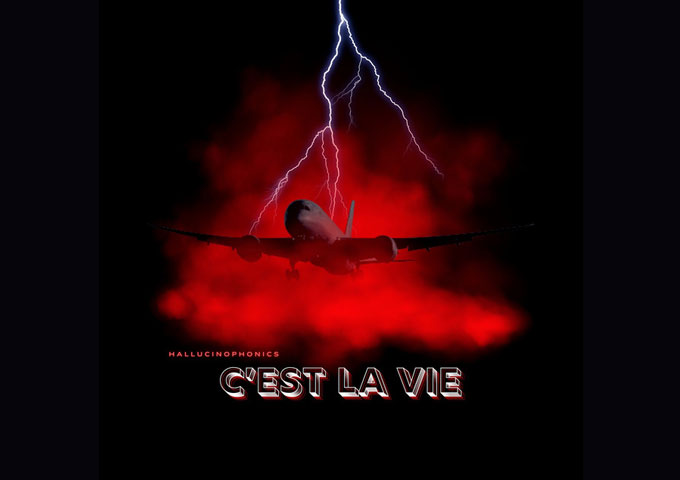
Hallucinophonics – “C’est La Vie”: Between the Stars and the Mind’s Eye
At the edge of sound and consciousness lies Hallucinophonics—a name that already feels like an open portal. Their music does not simply play; it unfolds, like a dream you can walk through, a landscape of color and texture that pulses between awareness and illusion. With their latest single, “C’est La Vie”, the band delivers a hypnotic and transcendent experience—an odyssey through sound, emotion, and existential surrender.
Drawing inspiration from the cosmic explorations of Pink Floyd and the forward-thinking sonic design of Tame Impala, Hallucinophonics craft a sound that feels both timeless and futuristic. Their compositions are not mere songs but living organisms—fluid architectures of tone and rhythm designed to elevate the listener’s consciousness. Within their work, you can hear the delicate fusion of art and philosophy: ethereal textures weave into tribal beats, progressive structures dissolve into formless ambience, and everything seems to vibrate with the energy of something ancient and unknown.
“C’est La Vie” is, at its core, a meditation on apocalyptic acceptance—the act of finding beauty in the inevitable collapse of things. Written in E minor and unfolding at a deliberate 111 BPM, the track unfolds like a slow-motion revelation. The haunting male vocals float through the atmosphere like spectral whispers, anchored by flowing guitar lines that shimmer with melancholic grace. Beneath it all, tribal percussion throbs with primal insistence, evoking the pulse of human history—our endless cycles of creation, destruction, and rebirth.
The song begins in a haze of lush synthesizers, evoking the vastness of interstellar space. The tone is immediately cinematic—massive, glacial, and full of portent. Then, slowly, the guitars emerge: warm, gently distorted, and unmistakably reminiscent of David Gilmour’s soulful phrasing. These tones don’t simply enter; they bloom, wrapping the listener in waves of nostalgia and wonder.
From there, the arrangement takes on the fluid complexity of progressive rock. It’s a sonic ecosystem where every sound has its purpose, every echo its shadow. The verses drift in a delicate balance between serenity and tension, while the refrain delivers a striking emotional punch. It’s not a chorus designed to shout—it’s one that haunts, murmuring truth rather than demanding attention.
What makes “C’est La Vie” particularly compelling is how it bridges eras and aesthetics. There’s a distinctly retro flavor—echoes of Porcupine Tree, Tool, and even the raw experimentation of early 1980s NWOBHM—that gives the track an unmistakable authenticity. The production feels like a lost gem discovered in some forgotten corner of rock history, perhaps unearthed from a John Peel radio session or a long-lost Neat Records archive.
Yet despite its vintage tones, the spirit of the song is resolutely modern. The balance between analog warmth and digital precision is masterfully executed. The result is a track that feels suspended between decades—equally comfortable in the vinyl era as it is in the age of streaming and AI-driven artistry. Hallucinophonics understand that progress does not mean abandoning the past; it means reinterpreting it through a new consciousness.
As the track evolves, it expands into a full-blown cosmic tapestry. Guitar lines stretch into infinity, basslines move like tectonic plates beneath the surface, and the percussion becomes ritualistic—almost shamanic. There’s a sense of revelation, a glimpse into something larger than ourselves. Then, just as the sound reaches its zenith, it begins to dissolve—melting back into the void from which it came. The ending is both inevitable and transcendent: a musical sigh that echoes the title’s fatalistic wisdom. C’est la vie.
To understand Hallucinophonics is to accept that their work transcends genre. They do not simply inhabit the world of psychedelic or progressive rock—they redefine its parameters. Their music functions as an act of exploration, both sonic and spiritual. Each composition is a ritual in itself, a quest for deeper understanding through the vibration of sound.
Themes of existential discovery and the evolution of consciousness run through their catalog like threads of light. The band’s approach to music feels almost alchemical: merging the cerebral with the celestial, the rational with the ecstatic. In their world, rhythm becomes heartbeat, melody becomes mantra, and harmony becomes a map of the inner universe.
In this sense, “C’est La Vie” stands as more than just a single—it is a microcosm of the band’s entire philosophy. It captures the tension between acceptance and defiance, between the human need for meaning and the cosmic indifference of the universe. The song invites listeners to let go—to surrender to the flow of existence with grace and curiosity, even in the face of uncertainty.
There’s something deeply nostalgic about “C’est La Vie”, yet it doesn’t feel trapped in the past. It is a song that remembers what made rock music a spiritual force in the first place: its ability to transform emotion into revelation. Every note feels intentional, every silence sacred. The track invites repeated listening, not for analysis but for immersion.
And that is where Hallucinophonics truly excel. They create music not just for the ears but for the psyche. Their art asks questions that words alone cannot answer—questions about identity, time, mortality, and the infinite nature of perception. Listening to “C’est La Vie” feels like drifting through a dream you half-remember: familiar yet alien, soothing yet unsettling, always on the brink of awakening.
In an age of disposable singles and algorithmic playlists, Hallucinophonics remind us that music can still be sacred. That sound can still open doors within us. That, indeed, c’est la vie—life in all its fragile, fleeting, beautiful impermanence. “C’est La Vie” by Hallucinophonics is available now on all major streaming platforms. Step into the sound, close your eyes, and let consciousness and cosmos collide.