
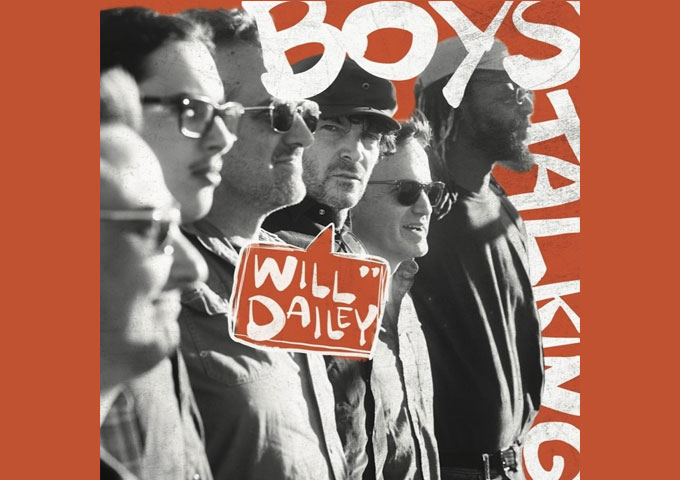
Will Dailey’s Boys Talking Is the Album That Refuses to Be Swallowed by the Machine
There is something quietly radical about the way Will Dailey has chosen to move through the music industry. While most artists scramble to feed the algorithm, refreshing streaming dashboards and chasing playlists, the Boston-based singer-songwriter has spent the better part of eighteen months letting his seventh album breathe in the physical world, on vinyl, on CD, and through direct download, before allowing it anywhere near what he calls “the digital abyss.” That patience, that almost stubborn confidence in his own work, tells you everything you need to know about Boys Talking before you’ve heard a single note.
Dailey is no newcomer navigating the industry in the dark. He has spent the better part of two decades testing the machinery of mass-market success, recording for major labels as both a solo artist and as the creative engine behind the sonically ambitious rock outfit the Rivals, a band unafraid to invite symphonies into the room. But for Boys Talking, he has returned to something closer to his origins, the spirit of his self-funded 2004 debut Goodbyeredbullet, trusting his instincts and his collaborators over corporate infrastructure. From nearly eighty tracks in varying states of completion, ten were chosen. Overdubs were kept deliberately sparse. The result is an album that breathes like a living thing, warm and unhurried, with space enough between the notes to feel genuinely human.
The cast assembled around Dailey is as diverse as the album’s emotional register. Longtime collaborator Dave Brophy anchors the project alongside Boston scenester and indie icon Juliana Hatfield, celebrated music photographer Danny Clinch, Puerto Rican cuatrista and Emmy-nominated composer Fabiola Méndez, and award-winning bilingual singer-songwriter Alisa Amador. Together they have helped fashion something that resists easy genre classification. Kaleidoscopic Americana for the post-Spotify age feels about right, though even that label undersells the ambition at work here.
The album opens with “Make Another Me”, featuring Juliana Hatfield, and wastes no time in establishing its thesis. Dailey conjures a world in which privacy has been quietly drained away, in which loneliness is monetized and identity is cataloged and sold back to us. Yet the song refuses despair. There is something almost liberating in its climax, the idea that if “they” have already built another you from your data, you might as well hand that copy the laundry and go start a revolution.
“Send Some Energy” follows, a visceral response to national tragedy and the suffocating passivity that tends to follow it. Dailey reaches, almost mystically, toward David Bowie as a spiritual lodestone, tapping into the late icon’s energy as a tool for transcendence. It is genuinely moving, the kind of song that sounds like it was written under pressure, because it was.
“One At A Time” pivots with sharp wit into a meditation on Hollywood masculinity and the myth of the lone hero, using the absurd choreography of action-movie fight scenes as a lens through which to examine trauma, ego, and the ways men transfer rather than process pain. It is the album’s most intellectually playful track, and one of its most incisive.
“My Old Ride”, featuring Danny Clinch, is arguably the album’s centrepiece and certainly its most celebrated moment. Recorded almost on a whim during the live studio sessions, the third take became the album version, and it shows in the best possible way. Raw, immediate, and deeply felt, the song has earned significant radio play, was considered for a Grammy nod for Best Americana Roots Performance, and has become a live favourite that Dailey has even discussed with Bruce Springsteen. That pedigree is well earned.
“Hell Of A Drug” takes aim at cult mentality with sardonic precision, acknowledging the seductive pull of collective delusion even while dissecting its damage. Dailey’s conflicted envy for the bliss of the true believer gives the song a moral complexity that elevates it well beyond polemic.
“After Your Love” is perhaps the album’s most intimate confession, a song born from a forgotten guitar tuning that led Dailey to a truth about the nature of desire: that the chase itself, the process of pursuit, holds more beauty than any arrival. It is a rom-com philosophy applied to creativity, and it lands with quiet force.
“Tremble On Me” is where Boys Talking bares its deepest wound. Written in grief, for a friend and a mentor both lost, the song initially existed only as a chorus because the verses required truths not yet accessible through the fog of mourning. The benefit of recording live and quickly, Dailey notes, is that there is no time to overthink. Time, and music, eventually opened the door. A final text from his departed friend, read aloud in the track’s notes, is devastating in the gentlest way.
“Alright Already” serves as the album’s palette-cleanser, an intentional exhale after so much searching and feeling. Existing only as a secret track on the physical release, it is Dailey drawing a deliberate line: not everything needs to live in the digital abyss. Some things belong only to those willing to hold them in their hands.
“How To Cry” arrives as something close to a field manual for emotional literacy, patient in its tempo and generous in its understanding that grief and release are learned behaviours, slowly reformed with the right companionship. The guitar solo that closes it out is genuinely cathartic.
The album ends with “Sometimes The Night”, featuring Alisa Amador, whose voice brings a luminous tenderness to Dailey’s most empathetic lyric. Written for every woman elevated and then destroyed for public entertainment, the song offers the night as sanctuary, a place beyond the definitions others have imposed, where something new and self-owned might finally grow.
Boys Talking is the work of an artist who has nothing left to prove to an industry and everything left to say to the world. It earns its confidence on every track.
OFFICIAL LINKS: FACEBOOK – BANDCAMP – SPOTIFY – INSTAGRAM – YOUTUBE