
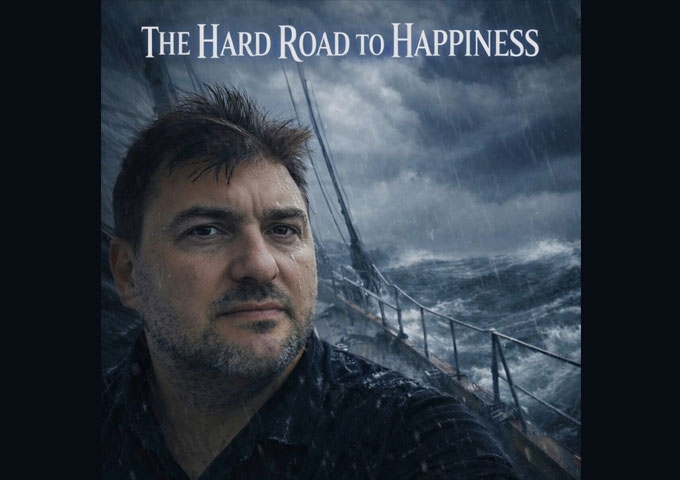
Robert Kleeman Bares His Soul on “The Hard Road to Happiness”
A Houston drummer turned frontman channels 26 hospital days into a slow-burning alternative anthem about anxiety, breath, and the fight to feel steady again. The result is raw, cathartic, and impossible to look away from.
Anxiety rarely announces itself with drama. It creeps in through the ribs, tightens the throat, and makes the ordinary act of breathing feel like a negotiation. That is the terrain Robert Kleeman stakes out on “The Hard Road to Happiness,” his new alternative rock single and power ballad, released in early 2026. It is a song built for anyone who has ever lain awake convinced their own lungs might betray them, and it arrives from an artist who has lived that fear closely enough to sing it without flinching.
Kleeman is a drummer, singer, and songwriter from Houston, Texas, whose path back to music began in an unlikely place: a hospital bed. A 26-day stay last fall pulled him out of a long musical dormancy and pushed him toward something he needed to say. “The Hard Road to Happiness” is that something, a track he describes plainly as spilling his guts, a wail directed at anyone fighting through a storm of apprehension or a mental health crisis of their own.
Musically, the song earns the term power ballad in the truest sense. It opens with restraint, a piano line that aches with longing, patient and unresolved, before the arrangement gradually swells into stadium-ready drums that arrive like a held breath finally released. That structural build is not decoration. It mirrors the emotional arc of the lyric itself, the slow, grinding climb out of a mental spiral toward something resembling solid ground. Kleeman’s background behind the kit shows in how the song is paced. He understands the power of restraint, of letting tension accumulate before the release hits, and that instinct gives the track its cathartic payoff rather than a cheap one.
His vocal performance is the emotional center of gravity here. Soul-driven and unguarded, it carries the weight of someone who is not performing distress but describing it from memory. There is a rawness in his delivery that resists polish, and that choice feels deliberate. Kleeman has said he wanted to capture the desire to sail away from inner discomposure toward something steadier, and you can hear that yearning in every held note, a voice reaching past its own exhaustion toward hope.
Lyrically, “The Hard Road to Happiness” sits with the specific, haunting fear that anxiety sufferers know intimately: the sense that control could vanish at any moment, that breathing itself might simply stop. Rather than softening that fear into metaphor, Kleeman names it directly, and that honesty is the song’s greatest strength. Too much music about mental health settles for vague gestures toward struggle. This track instead insists on specificity, on the particular texture of what it feels like to live inside a hurricane of disquiet while still, somehow, reaching for the other side of it.
That reach toward hope is what keeps the song from tipping into despair. Kleeman frames the track as a message in a bottle, a form of solidarity extended to listeners who feel swallowed by their own anxious minds. The song’s title itself captures its thesis: happiness is not framed as an easy destination or a switch to flip, but as a road, long and difficult, that has to be walked one exhausted step at a time. There is no false promise of instant relief here, only the assurance that someone else has walked a similar road and lived to write about it. For listeners in the thick of their own mental health battles, that kind of honesty can matter more than any tidy resolution.
The song was tracked at Studio 713 in Houston, where Kleeman recorded both the vocals and the drums himself, a hands-on approach that runs through his broader catalog. That physical closeness to the material, playing the rhythm section that drives his own confession forward, gives the recording an intimacy that a purely produced, outsourced session would struggle to replicate. It sounds like a song made by someone who needed to make it, not one assembled to fit a formula.
Kleeman’s origin story adds another layer of resonance to the track. He traces his desire to perform back to watching Phil Collins tear through an athletic drum solo at The Summit in Houston, a childhood memory that planted the seed of wanting to do exactly what he was witnessing. Decades later, that same instinct for physical, felt performance animates “The Hard Road to Happiness,” even if the subject matter has grown considerably heavier than a stadium drum solo. He writes and sings about mental health alongside other subjects that matter urgently to him, insisting that his lyrics, melodies, and riffs are entirely his own. In an industry increasingly shaped by outside writers and formulaic hooks, that insistence on authorship carries weight.
What makes “The Hard Road to Happiness” land is its refusal to dress up suffering in easy language. Kleeman does not ask listeners to admire his resilience from a distance. He invites them into the hurricane with him, then walks them, slowly and deliberately, toward calmer air. The power ballad format, often used for grand romantic gestures, is repurposed here for something more urgent: survival, and the courage it takes simply to name what is happening inside your own head.
Kleeman has described the track as one of the most personal and resonant works of his catalog, and it is easy to hear why. The song does not perform vulnerability so much as document it, verse by verse, breath by breath, until the arrangement finally breaks open into the release the whole track has been building toward. That release does not erase the anxiety it describes, but it offers something almost as valuable: proof that someone else has felt it too, and kept going anyway.
Currently in his 14th year of public education, Robert Kleeman dreams of eventually making music his full-time pursuit. Given the emotional precision and craft on display in “The Hard Road to Happiness,” that dream feels well within reach. For now, the song stands as both a personal reckoning and an open hand extended to anyone else still finding their own way down that same difficult road.