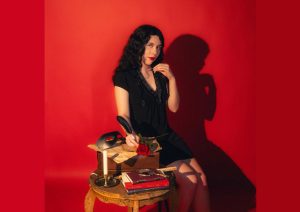

Lilli Zeifert Charts Her Own “Musical Path” With Alexandra-Yoana Alexandrova in an Empowering Celebration of Creativity, Courage, and Self-Determination
Born from a lifelong devotion to musical theatre, “Musical Path” transforms personal experience into a stirring declaration of artistic independence. Featuring the commanding soprano of Bulgarian-born, German-raised performer Alexandra-Yoana Alexandrova, Lilli Zeifert’s composition brings classical orchestration into dramatic Baroque Pop territory. Its theatrical arrangements and cabaret-inspired intensity give voice to a deeply personal story of ambition, identity, and perseverance. Created during a study-abroad semester in Vienna in 2025, the song reflects an artist discovering new ways to translate her imagination into sound. At its heart lies an unmistakable affirmation of ownership over one’s destiny: “I write my own musical path.”
Music can become a lifelong companion long before someone understands what it means to create it. For Lilli Zeifert, musical theatre was woven into the fabric of childhood, inspiring an enduring fascination with storytelling, performance, and the emotional architecture of a song. With “Musical Path”, featuring Alexandra-Yoana Alexandrova, that early passion takes on a new dimension. More than an introduction to Zeifert’s work as a songwriter and producer, the single is an autobiographical statement about artistic identity, personal agency, and the determination to pursue a creative future on one’s own terms.
Written during a study-abroad semester in Vienna in 2025, “Musical Path” reflects Zeifert’s evolution from an avid admirer of musical theatre into a writer whose own words can become the foundation of a musical production. Its central declaration, “I write my own musical path,” distills the philosophy behind the entire project. The line is both intimate and assertive, presenting creativity as a means of claiming authorship over a life that cannot always be navigated through conventional routes.
For Zeifert, that message carries profound personal significance. Born in 2001, the German writer lives with dyskinetic cerebral palsy caused by kernicterus following untreated newborn jaundice. Her disability affects her motor control, and she is nonverbal, communicates through a text-to-speech application, uses a wheelchair, and completes tasks with her feet. These circumstances have shaped how she interacts with the world, but they have not diminished the breadth of her artistic ambitions. Instead, she has developed a creative practice that adapts technology to her needs, allowing her ideas to move beyond the physical limitations imposed by her condition.
The distinction between artistic intention and the tools used to realize it is particularly important to understanding “Musical Path”. Zeifert writes the lyrics and uses AI-assisted tools as a practical means of developing their musical presentation. She retains responsibility for the final curation, arrangement, and remastering, directing the process according to her own creative judgment. In this context, technology functions as an instrument of access rather than a replacement for artistic vision. The song remains rooted in her personal experiences, her theatrical sensibilities, and the words she has chosen to express them.
Its very existence challenges narrow assumptions about who can participate in music-making and what the process must look like. Creativity does not belong exclusively to people who can play an instrument with their hands, sing their own compositions, or work within established production environments. Zeifert’s approach demonstrates that the desire to create can find alternative methods of expression, provided the necessary tools and opportunities are available. The result is not simply a song about overcoming obstacles. It is a practical example of an artist building a creative language that works for her.
Musically, “Musical Path” embraces the heightened emotional vocabulary of musical theatre while reaching toward the more expansive textures of classical orchestration and dramatic Baroque Pop. Its theatrical character creates space for grandeur, tension, and expressive contrasts, placing the composition firmly within a tradition where music does more than accompany a story. It actively shapes the drama, amplifies the emotional stakes, and draws listeners into the protagonist’s inner world.
The Baroque Pop influence brings a sense of ornate theatricality, while the classical orchestral elements suggest scale and emotional sweep. Rather than relying on understatement, the track aims for a heightened presentation in which melody, arrangement, and vocal delivery work together to communicate conviction. The cabaret and Showtime influences add another layer of performance-driven energy, giving the song a distinctly stage-conscious identity. This is music conceived with dramatic expression in mind, where a personal declaration can assume the proportions of a theatrical centerpiece.
That vision finds a compelling interpreter in Alexandra-Yoana Alexandrova, whose powerful soprano and extensive musical theatre experience provide the song with an appropriate vocal presence. Her performance brings the composition’s ambitions into focus, translating Zeifert’s autobiographical lyrics into a vivid, outward-facing statement. The pairing between lyricist and vocalist is particularly meaningful: Zeifert supplies the personal perspective, while Alexandrova gives that perspective a voice capable of carrying its emotional message into a performance space.
Born in Bulgaria and raised in Germany as part of the Danish minority, Alexandra-Yoana Alexandrova brings a rich cultural background and an exceptionally diverse artistic résumé to the collaboration. A performer whose work encompasses musical theatre, acting, singing, dancing, modeling, voice-over, vocal coaching, dramaturgy, and photography, she has cultivated a career that crosses disciplines and national borders. Her education includes musical theatre at the Music and Arts University of the City of Vienna (MUK) and studies in theatre, film, and media science at the University of Vienna, alongside further training in dramaturgy, film directing, photography, and video.
Her stage experience spans Austria, Germany, Denmark, Switzerland, and Bulgaria, with roles that demonstrate both vocal versatility and dramatic range. Such capability makes Alexandrova a natural fit for a composition built around theatrical expression. Musical theatre demands more than technical accuracy; it calls for the ability to communicate a character’s emotional journey through phrasing, dynamics, and vocal color. In “Musical Path”, that interpretive tradition serves a particularly personal purpose. Alexandrova is not merely delivering a dramatic song. She is helping bring another artist’s story to life, honoring the emotional perspective embedded in Zeifert’s writing.
Zeifert’s own history makes the song’s connection to musical theatre especially resonant. Her mother, Ines Zeifert, an opera singer and vocal coach, introduced her to music from an early age. That formative environment nurtured an interest that eventually developed into professional work as a musical theatre critic, journalist, novelist, librettist, songwriter, and producer. Her engagement with the art form has never been limited to one role. She has explored musical theatre as an audience member, an analytical observer, a writer, and now a creator working to bring her own lyrics into musical form.
At just 16, she wrote her debut novel, Meroks: Offenbarung, published in spring 2023. In 2020, she became the youngest musical theatre critic writing for the German platform Musicalzentrale, where she continues to contribute, while also beginning freelance editorial work for Blickpunkt Musical. She subsequently established her own review website in 2022, expanding an already substantial commitment to examining and communicating the creative achievements of others. In 2024, she added another significant milestone when Wo ist Fred? – Das Musical, co-written with Patrick Hehmann, premiered.
These achievements reveal an artist whose relationship with musical theatre has continually evolved. Criticism requires close attention to performance, narrative, structure, and emotional effect. Libretto writing calls for an understanding of how words function within a larger dramatic framework. Songwriting adds another challenge, asking language to find its expressive counterpart in melody and musical atmosphere. “Musical Path” brings these interests together, reflecting Zeifert’s accumulated experience while marking a new stage in her development.
Crucially, “Musical Path” does not need to be understood solely through the circumstances of its creation. Its musical identity, combining classical orchestral sensibilities, Baroque Pop drama, and a commanding soprano performance, gives it an expressive foundation of its own. Its message is most effective when the words, musical atmosphere, and performance converge around the same central idea: the right to determine one’s own direction.
“Musical Path” is a celebration of creative independence, but it is also an invitation to reconsider the relationship between ability, technology, and artistic possibility. Lilli Zeifert’s use of AI-assisted production tools demonstrates how technology can help remove barriers when it remains directed by a creator’s own intentions and decisions. Her authorship is expressed through the lyrics, the choices that shape their musical realization, and the persistence required to bring the work into the world.