
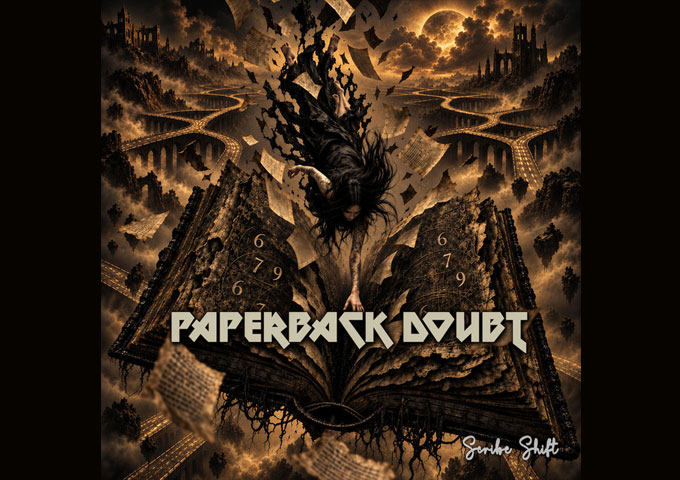
Scribe Shift Turns Self-Doubt into a Haunting Obsession on “Paperback Doubt”
Scribe Shift transforms the private struggle of overthinking into a dark, experimental alternative rock experience. “Paperback Doubt” explores the ways past failures can become invisible barriers to future possibilities. Led by composer and lyricist Luke Taylor, the British project places poetic imagery at the heart of its unsettling sound. Shifting dynamics, rhythmic bass, electronic textures, and an expressive erhu solo give the track its distinctive emotional character. Released October 2, 2026, the single opens another chapter in the lead-up to the forthcoming album Metamorphic Ruin, arriving December 4.
Self-doubt rarely announces itself as a single, definitive thought. More often, it accumulates through repetition, feeding on yesterday’s disappointments until tomorrow begins to resemble another opportunity for failure. On Scribe Shift’s second single, “Paperback Doubt,” that psychological entanglement becomes the foundation for a dark, shape-shifting alternative rock composition that treats uncertainty not simply as an emotion, but as an environment the listener must navigate. Rather than offering an easy resolution, British composer and lyricist Luke Taylor builds an immersive experience around the uncomfortable possibility that the mind can become both the source of our limitations and the mechanism that keeps us trapped within them.
Released on October 2, 2026, “Paperback Doubt” continues the conceptual direction of Scribe Shift, an independent project that places original lyricism, fractured imagery, and emotionally weighty atmospheres ahead of conventional song structures. The single also advances the journey toward the forthcoming album Metamorphic Ruin, scheduled for release on December 4, 2026. If its title suggests transformation emerging from destruction, this latest offering provides a compelling glimpse into the internal conflicts that can make such transformation difficult, frightening, and necessary.
The central image of a paperback book is particularly effective because it gives an intangible psychological struggle a physical form. A book contains a sequence of pages, chapters, and narratives, suggesting that experiences can be revisited, interpreted, and arranged into something resembling a coherent story. Yet the perspective behind “Paperback Doubt” complicates that reassuring idea. Instead of standing outside the narrative and deciding what it means, the narrator appears to become submerged within it, caught among the accumulated impressions of past failures and the imagined consequences of future decisions. The book becomes less a source of understanding than a place of confinement, with every remembered disappointment threatening to dictate what happens next.
This is where Taylor’s lyrical concept gains much of its emotional force. The past does not remain safely behind the narrator. It follows every new possibility, transforming the prospect of moving forward into a confrontation with everything that might go wrong. Even the desire to retreat becomes complicated when the mind continues to pull in the opposite direction, creating an exhausting conflict between the instinct for self-preservation and the longing to escape familiar limitations. The result is an unsettling portrait of indecision in which neither action nor withdrawal promises complete relief.
The recurring phrase “Six. Seven. Nine. Repeatedly.” functions as the song’s obsessive emotional centerpiece. Its abrupt numerical sequence feels deliberately detached from ordinary conversational logic, as though the narrator has become fixated on a private pattern that cannot be explained away. The absence of an obvious progression from six to seven to nine makes the sequence particularly suggestive. Rather than presenting a satisfying order, it introduces a small but persistent disturbance, a pattern that appears to demand attention without offering an answer.
Repetition gives that disturbance its power. The phrase begins to resemble the intrusive return of an unresolved thought, resurfacing regardless of whether the narrator wants to engage with it. Its clipped delivery also creates a rhythmic counterpoint to the song’s more expansive emotional passages, allowing a seemingly simple sequence to embody a much larger state of mental unrest. The numbers do not need an explicit explanation to become meaningful. Their significance lies in the way they occupy the mind, becoming a recurring signal of uncertainty that resists interpretation while refusing to disappear.
Musically, “Paperback Doubt” reinforces this tension through a dynamic arrangement that moves between restrained passages and forceful eruptions. The track does not depend on a single sustained level of intensity. Instead, its changing soundscape creates a sense of instability, with quieter moments allowing the underlying unease to gather before louder sections release that pressure. This movement between softness and aggression mirrors the narrator’s shifting relationship with their own thoughts, moving from inward contemplation toward something closer to emotional overload.
The prominent bass is central to that experience. Its rhythmic presence gives the composition a physical pulse, anchoring the more experimental elements while contributing to the track’s sense of restless forward motion. Rather than simply serving as a conventional foundation, the bass helps establish an atmosphere in which tension feels continually active. Electronic textures further complicate the arrangement, introducing additional layers that deepen its shadowy character without smoothing away its rougher edges.
One of the most distinctive features is the use of Asian-inspired instrumentation, particularly the erhu, whose expressive string sound introduces a different emotional dimension to the alternative rock framework. Its penetrating, almost vocal quality lends the track a sense of lamentation, intensifying the feeling that something remains unresolved beneath the surface. The instrument does more than provide an unusual sonic accent. Its presence creates a striking contrast with the bass-driven passages and electronic textures, giving the arrangement a distinctive timbral identity while amplifying the song’s atmosphere of vulnerability and unease.
The female vocal performance is equally important to the track’s dramatic progression. Moving between emotional whispers and soaring, full-bodied roars, the voice gives the lyrics an expressive range that extends beyond the words themselves. The quieter passages suggest a struggle still being processed internally, with thoughts barely articulated before they threaten to overwhelm the narrator. When the performance rises into more powerful territory, that suppressed tension becomes impossible to ignore. The contrast between fragility and force also prevents the song from becoming emotionally one-dimensional. Beneath its bleakness, there is a formidable sense of resistance, as though the act of expressing the struggle represents a refusal to remain entirely consumed by it.
This interplay between lyrical intimacy and musical experimentation reflects Scribe Shift’s broader creative philosophy. Taylor writes the lyrics himself, beginning with original images and texts before using generative tools to develop the music around those ideas. The distinction matters because it places the written concept at the heart of the process, with technology serving as an instrument for translating an established creative vision into a finished musical form. In a landscape where discussions of AI-generated music can quickly become preoccupied with novelty or controversy, Scribe Shift offers a more specific point of interest: the relationship between human-authored language, conceptual intent, and the possibilities of technologically assisted composition.
The result is a track whose identity rests on the interaction between its components. The lyrics provide the psychological framework, the shifting arrangement recreates the instability of that inner experience, and the contrasting instrumental colors give it an atmosphere that is difficult to reduce to straightforward alternative rock. Its experimental touches feel connected to the song’s subject rather than added merely for effect, allowing its sonic unpredictability to reinforce the uncertainty at its core.
Ultimately, “Paperback Doubt” succeeds by resisting the temptation to turn an uncomfortable subject into a neatly packaged lesson about overcoming adversity. It recognizes that self-doubt can persist even when a person understands its destructive patterns, and that recognizing a cycle does not automatically provide the means to escape it. The song’s strength lies in making that contradiction tangible through repetition, dynamic tension, and a performance that balances vulnerability with emotional intensity.
As the second single leading toward Metamorphic Ruin, “Paperback Doubt” establishes Scribe Shift as a project interested in the uneasy spaces where identity, memory, and imagination collide. Luke Taylor’s conceptual writing gives the track its central preoccupation, while the restless bass, experimental textures, erhu passages, and dramatic vocals transform that preoccupation into an absorbing musical experience. It is a dark and compelling study of a mind caught between the desire to move forward and the fear of repeating its past, leaving the listener with a question that lingers long after the final notes: when doubt becomes the story we tell ourselves, how do we begin to imagine a different ending?
OFFICIAL LINKS: SPOTIFY – INSTAGRAM – FACEBOOK – YOUTUBE – TIKTOK