
A Day in Venice Embraces Existential Freedom and the Beauty of the Present on “You’re in the Now” ft. Froop
An immersive collision of cinematic alternative rock, atmospheric shoegaze and experimental art-rock, “You’re in the Now” explores the freedom of letting go. A Day in Venice’s Andrej Kralj constructs an expansive instrumental landscape that balances brooding intensity with moments of introspective clarity. Guest vocalist Froop brings an expressive human dimension to a composition built around the urgency of experiencing life as it unfolds. Its deceptively minimal lyrics challenge our attachment to ambition, possessions and the endless pursuit of something more. Accompanied by a strikingly unfiltered lyric video, the single encourages listeners to rediscover the extraordinary beauty hiding within ordinary moments.
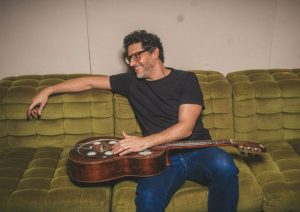
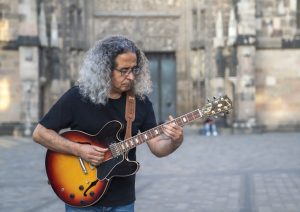
What happens when the pursuit of everything finally loses its importance? When ambition, expectation and the constant desire for something more begin to dissolve, what remains? These existential questions lie at the heart of “You’re in the Now,” the compelling new single from A Day in Venice, the independent artistic project of Italian musician, songwriter and multidisciplinary creator Andrej Kralj, featuring guest vocalist Froop (Peggy-Sue Mackey). Blending cinematic alternative rock, shoegaze atmosphere and art-rock experimentation, the track develops a hypnotic musical environment in which emotional release and heightened awareness become intertwined.
Operating from his own studio in Trieste, Italy, Kralj approaches music as an intensely personal, self-contained creative process. He writes the compositions and lyrics, performs every instrument, and oversees recording, production and mixing, maintaining complete artistic control over the finished material. Yet this independence never feels like an exercise in technical self-sufficiency. Instead, it allows his compositions to develop according to an individual vision, with guest vocalists introducing additional personalities and interpretations. On “You’re in the Now,” Froop provides precisely that complementary presence, bringing a distinctive vocal character to music that thrives on the contrast between expansive instrumentation and deceptively straightforward lyrical expression.
Musically, the single establishes its identity through atmosphere, repetition and carefully cultivated tension. Its alternative rock foundations are enriched by spacious guitar textures and a shoegaze sensibility that favors immersion over conventional immediacy. Rather than relying on an uncomplicated verse-and-chorus progression, the arrangement draws listeners into a sustained sonic experience, allowing its instrumental layers and rhythmic persistence to create a sense of forward momentum. There is a brooding quality to the surrounding sound, but also an underlying expansiveness that prevents the composition from becoming emotionally restrictive. The result feels simultaneously introspective and physically engaging, with the instrumentation providing a substantial counterweight to the philosophical simplicity of the central refrain.
Froop’s performance is particularly important to this balance. Her voice gives the composition a human focal point, navigating the space between restrained contemplation and the more insistent, chant-like repetition of the central hook. That contrast reinforces the song’s underlying proposition: awareness does not necessarily arrive through elaborate explanations or dramatic revelations. Sometimes, the most meaningful realization is also the simplest. Against Kralj’s carefully constructed musical backdrop, Froop’s delivery gives those words an almost mantra-like persistence, allowing their meaning to accumulate through repetition rather than excessive elaboration.
The lyrics initially present an intriguing paradox. The opening declarations, beginning with the assertion of having nothing to lose and nothing left to see, suggest someone who has reached a point of complete detachment. The language could initially be interpreted as resignation, emotional exhaustion or even disillusionment. However, the progression toward the idea of having already seen everything introduces another possibility. Perhaps the narrator is no longer measuring existence through what remains to be acquired or experienced. Perhaps the familiar mechanisms of wanting, accumulating and anticipating have simply exhausted their significance.
This interpretation becomes particularly compelling in the repeated statements about having nothing to gain, nothing to sell and no more wants. These are unusually stripped-down expressions in a culture where identity is frequently connected to achievement, possessions, productivity and the constant presentation of personal value. The reference to having nothing to sell is especially interesting because it can suggest freedom from the pressure to package oneself, satisfy expectations or continually prove one’s worth. Without something to gain, there is no longer a compelling reason to pursue every opportunity. Without something to sell, there is less need to perform an identity for external approval.
Importantly, the lyrics do not attempt to provide a detailed philosophical explanation. Their minimalism is fundamental to their effectiveness. The repeated vocabulary of nothingness gradually shifts from apparent deprivation toward the possibility of liberation. Having nothing becomes less about an absence of meaningful experience and more about removing the distractions that prevent genuine engagement with life. The distinction is subtle but significant. The song does not necessarily advocate abandoning ambition or rejecting the material world altogether. Rather, it questions the extent to which our desires and expectations can prevent us from recognizing what is already happening around us.
The recurring refrain, “You’re in the now,” consequently becomes the composition’s defining statement. Its repetition is almost hypnotic, transforming a straightforward observation into an increasingly insistent reminder. The emphasis is not on remembering the past or imagining a future in which everything finally falls into place. It is on recognizing the immediate reality of one’s existence. The repeated use of the word now also gives the lyrics their rhythmic identity, creating a memorable vocal motif that becomes more powerful through its simplicity.
There is an interesting tension between the apparent detachment of the verses and the insistence of the refrain. The former strips away desire and expectation, while the latter demands attention. This is not passive withdrawal from the world but an invitation to experience it without constantly negotiating its value. The song’s central idea is therefore less about having nothing than about discovering what becomes possible when the need for more no longer dictates every thought.
This philosophy extends into the official lyric video, whose visual approach complements the music without resorting to elaborate effects or artificial embellishment. The photographs were captured during a single session lasting only a few minutes, documenting rust, weathered surfaces and fleeting moments of quiet tenderness. No filters or AI were applied. There is something particularly appropriate about this decision. Just as the lyrics encourage listeners to pay attention to the present rather than chase an imagined alternative, the photographs invite them to reconsider the ordinary details that might otherwise escape notice. Worn materials and seemingly insignificant visual fragments acquire an unexpected beauty when observed with patience.
That creative instinct reflects Kralj’s broader artistic practice, which also encompasses painting, poetry and the invention and construction of musical instruments. His interest in how things are imagined, developed and brought into existence informs Forms Taking Shape, his conversation series exploring creativity and music production. It is an extension of the same curiosity that informs his independent recording process, where songwriting, performance, experimentation and visual expression belong to a connected artistic discipline.
With “You’re in the Now,” A Day in Venice delivers a thoughtful and sonically absorbing exploration of presence, detachment and the freedom of relinquishing unnecessary expectations. Kralj’s expansive instrumental construction and Froop’s expressive vocal contribution give the song a distinctive identity, while its economical lyrics leave considerable room for individual interpretation. Rather than prescribing a particular way of living, the track offers a reminder that existence does not always need to be improved, acquired or explained to be meaningful. Sometimes, recognizing the moment already unfolding around us is the most important discovery of all.
OFFICIAL LINKS: SPOTIFY – INSTAGRAM – FACEBOOK – YOUTUBE – BANDCAMP