
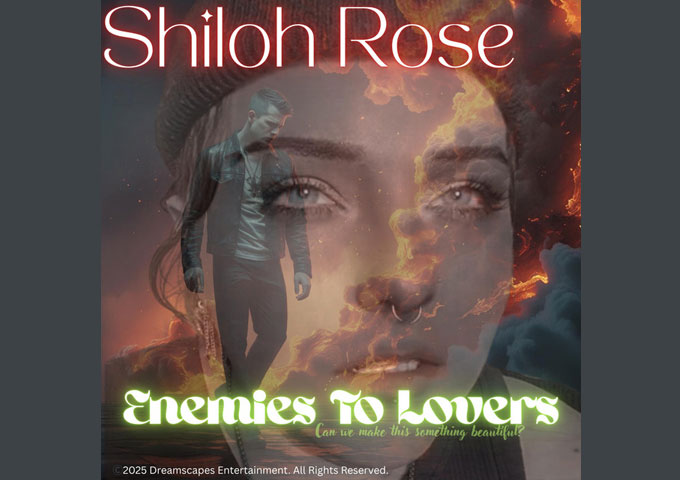
The Exquisite Agony of Forbidden Love: Shiloh Rose Delivers Cinematic Perfection with “Enemies to Lovers”
If you are tired of surface-level romanticism and predictable pop formulas, Shiloh Rose emerges as a masterful architect of emotional complexity with her latest single “Enemies to Lovers”. Released through Dreamscapes Entertainment, this haunting three-minute-and-thirty-one-second opus transcends conventional songwriting to deliver something genuinely transformative—a visceral exploration of love’s most paradoxical territory.
The track opens with an admission that immediately establishes its emotional stakes: the intoxicating suffocation of desire that defies logic and social boundaries. Rose‘s haunting vocal delivery carries the weight of internal conflict, her voice floating between vulnerability and strength as she navigates the treacherous waters of forbidden attraction. The production mirrors this emotional turbulence through carefully constructed layers of dark pop textures, where ethereal synth washes build like gathering storm clouds against a steady, hypnotic percussion that feels like a racing heartbeat.
What sets “Enemies to Lovers” apart from countless love songs is its unflinching examination of the psychological warfare that precedes genuine intimacy. Rose doesn’t merely sing about falling in love; she dissects the brutal beauty of emotional transformation with surgical precision. The lyrics paint a portrait of two souls locked in a dance between hostility and desire, where possession becomes tenderness and conflict evolves into connection.
The recurring motif of making “something beautiful” from this chaos speaks to the human capacity for redemption through love. Rose‘s vocal interpretation of these lines carries years of emotional weight, suggesting not just personal experience but a universal understanding of how love can emerge from the most unlikely circumstances. Her delivery transforms what could have been a simple romantic narrative into something approaching philosophical inquiry.
Musically, the track demonstrates Rose‘s sophisticated understanding of dynamics and space. The slow-burning synth arrangements create an atmospheric cocoon that allows her vocals to breathe and expand, while the steady rhythmic foundation provides grounding for the emotional flights that define the song’s most powerful moments. The production choices echo the lyrical themes—tension and release, darkness and light, conflict and resolution—creating a sonic landscape that feels both intimate and cinematic.
The central metaphor of enemies becoming lovers serves as more than just romantic imagery; it becomes a meditation on human nature’s capacity for radical change. Rose explores the hesitation and mistrust that inevitably accompany such transformations, acknowledging the fear that comes with vulnerability. The line about clever disguises speaks to the defensive mechanisms people employ when faced with unexpected emotional territory, while the admission that “none of this was planned” captures the beautiful chaos of authentic human connection.
Perhaps most compelling is how Rose handles the temporal aspect of this transformation. The progression from “at each other’s throats” to becoming “one in one” doesn’t feel rushed or artificially dramatic. Instead, it unfolds with the organic inevitability of real emotional evolution, supported by production choices that mirror this gradual metamorphosis. The repeated chorus becomes less questioning and more declarative as the song progresses, reflecting the characters’ growing acceptance of their changed circumstances.
The comparison to Lana Del Rey, Fleurie, and Ruelle is apt but ultimately limiting. While Rose certainly shares their affinity for atmospheric pop and emotional gravitas, her approach feels distinctly personal and contemporary. Where Del Rey often drowns in nostalgic melancholy and Ruelle leans heavily into cinematic drama, Rose finds a middle ground that feels both timeless and urgently relevant.
The track’s structure mirrors its thematic content brilliantly. The verses function as internal monologues, spaces for doubt and self-examination, while the chorus becomes a kind of mantra—a repeated affirmation of transformation that grows stronger with each iteration. This structural choice reinforces the psychological journey at the song’s heart, where repetition becomes acceptance and acceptance becomes strength.
“Enemies to Lovers” succeeds because it refuses to simplify complex emotional territory. Rose doesn’t offer easy answers or fairy-tale conclusions. Instead, she presents love as a form of beautiful destruction—something that fundamentally alters the people who experience it. The question “should we be afraid” isn’t answered definitively; instead, it hangs in the air like incense, acknowledging that transformation always carries risk.
From a technical standpoint, Rose‘s vocal performance deserves particular praise. She navigates the song’s emotional landscape with remarkable control, knowing exactly when to push toward power and when to retreat into whispered vulnerability. Her phrasing choices feel intuitive rather than calculated, suggesting an artist who has internalized the emotional content rather than simply performing it.
“Enemies to Lovers” positions Shiloh Rose as an artist capable of meaningful artistic growth and emotional sophistication. In an era where many pop songs feel disposable, she has created something with genuine staying power—a track that rewards repeated listening and deeper contemplation. This is music for people who understand that the most profound connections often emerge from the most unlikely circumstances, and that love, at its best, changes everything.
Dreamscapes Entertainment has found a genuine talent in Shiloh Rose, an artist who understands that the most powerful music doesn’t just entertain—it transforms. “Enemies to Lovers” stands as compelling evidence that authentic artistry still exists in contemporary pop music, waiting for those brave enough to embrace its complexities.
OFFICIAL LINKS: SPOTIFY – DREAMSCAPES ENTERTAINMENT