Deena Maddox Blooms Beautifully on Her Tender New Single “Wildflowers”
There is something quietly radical about an artist who refuses to chase the noise. In a music landscape that often rewards spectacle over sincerity, Deena Maddox arrives with the kind of songwriting that asks you to slow down, breathe, and feel something real. The Texas-born, Las Vegas-based singer-songwriter has been quietly building a body of work rooted in emotional honesty, and her latest offering, “Wildflowers”, is perhaps her most luminous statement yet.
Maddox occupies a rare and precious space in contemporary country music. Self-taught on guitar and shaped by a lifetime of deep listening, she weaves together the classic warmth of traditional country storytelling with the kind of soulful modern sensibility that recalls artists like Kacey Musgraves or early Taylor Swift, yet remains distinctly and unapologetically her own. Her voice, warm and emotive as a late-afternoon sun, carries the particular gift of making listeners feel they are being spoken to directly, personally, with nothing held back.
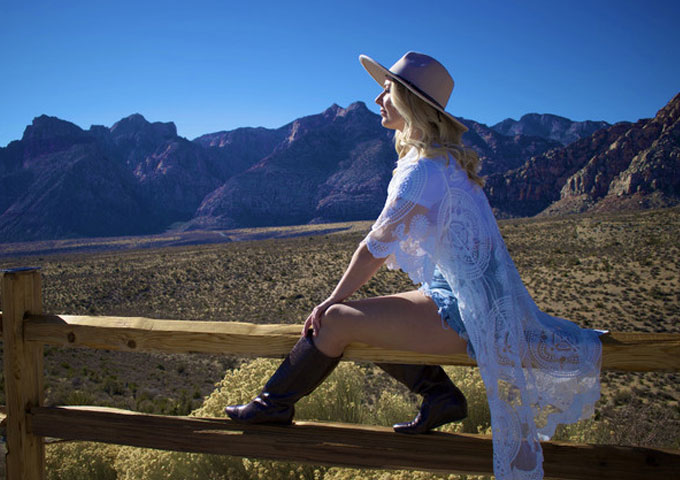
“Wildflowers” opens with a simple, irresistible invitation. The narrator wants to meet someone in a field at golden hour, that fleeting window of early evening light that photographers and poets have always understood to be sacred. From the very first lines, Maddox establishes the song’s central philosophy: that the most meaningful human experiences are not the grand, planned ones, but the unscripted moments we allow ourselves to fully inhabit. The field of wildflowers is not merely a pretty backdrop. It is a state of being, a symbol of untamed freedom and the vulnerability required to love without a map.
What makes the lyrical architecture of this song so quietly sophisticated is how Maddox holds two truths in tension simultaneously. On one hand, there is the ache of impermanence, the clear-eyed acknowledgment that time cannot be kept or owned. On the other, there is a fierce and tender insistence that the present moment, this magic hour, is not a consolation prize but the whole point. “We can’t take time with us, but here and now is enough” is one of those deceptively simple lines that rewards sitting with. It is not resignation. It is wisdom.
The song’s middle passages deepen this emotional landscape with beautiful, unhurried imagery. Walking hand in hand through the grass, no itinerary, no performance, just two people and the land beneath their feet. Maddox distills the essence of genuine connection down to its most elemental form, and in doing so, she quietly challenges the cultural obsession with destination over journey. Her protagonist does not want a grand gesture. She wants to be “free like a song in the evening breeze,” which is one of the album’s most evocative lines and one that feels entirely natural rather than constructed.
There is also a thread of quiet courage running through “Wildflowers” that deserves recognition. The repeated refrain “maybe you could fall for me” is not the declaration of someone certain of the outcome. It is an offering, open-handed and unhurried, from someone willing to be seen without the armor of certainty. This emotional bravery is central to Maddox’s artistry. She does not write from a place of resolution but from the honest, trembling middle of human experience, which is precisely why her songs land so deeply.
As the track moves toward its finale, the imagery shifts from golden to incandescent. The sky turns from pink to fire, hearts lit like stars, and the dancing is slow and deliberate, two people moving as though they have finally, fully arrived somewhere. The line “like we’ve both found our power” reframes the entire song in a quietly triumphant light. This was never simply a love song. It is a song about reclaiming the self through connection, about discovering that presence, not possession, is where true freedom lives.
Musically, “Wildflowers” is constructed with the kind of restraint that speaks of genuine confidence. Built around intimate acoustic textures and a cinematic yet grounded arrangement, the production serves the emotion rather than overwhelming it. There is no unnecessary ornamentation here, no reaching for a bigger sound at the expense of truth. Maddox’s vocals sit at the warm, close center of the track, and the result is something that feels as organic and unforced as the imagery it conjures.
This commitment to authenticity over overproduction is a hallmark of Maddox’s broader artistic identity. As an independent artist, she operates with complete creative integrity, and that freedom is audible in every choice made on this record. “Wildflowers” joins her recent single “When the River Rose”, a deeply moving tribute inspired by the devastating Texas floods in Kerr County, in forming a body of work that demonstrates remarkable emotional range. Where “When the River Rose” reaches outward toward community and collective grief, “Wildflowers” turns inward, toward the personal and the tender. Together, they reveal an artist equally capable of holding the intimate and the universal.
Deena Maddox is the kind of songwriter that the country genre needs more of right now: grounded, genuine, and utterly unafraid to trade gloss for grace. “Wildflowers” is not a song that announces itself loudly. It does something far more lasting. It lingers, the way golden hour does, the way certain conversations do, long after the light has changed and the moment has passed. Step into the field. You will not regret it.
OFFICIAL LINKS: FACEBOOK – X – SPOTIFY – INSTAGRAM – YOUTUBE