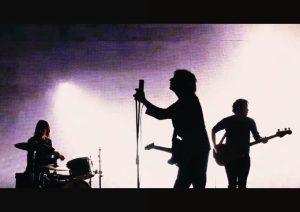

Nate Walker and The Outlaws Capture the Dust and the Dream in “Empty Lives”
There’s a certain kind of silence that hangs over the desert just before sundown – that stillness between memory and motion, between the man you were and the man you’ve become. Nate Walker and The Outlaws have managed to trap that silence, that ache, that clarity, and turn it into song with “Empty Lives,” the emotional centerpiece of their new album, Crimson Tide.
With grit in their guitars and soul in their bones, Nate Walker and The Outlaws bring the outlaw tradition roaring into the present day. Their sound is equal parts Waylon Jennings dust, Springsteen muscle, and The War on Drugs atmosphere – a collision of country storytelling and rock urgency. But beneath the swagger, there’s a poet’s heart. “Empty Lives” doesn’t just tell a story; it lingers like smoke in a dimly lit bar, curling around the listener long after the last note fades.
From the first measures of “Empty Lives,” you can hear the band’s pulse – that rugged blend of open-road guitars, anchored by a rhythm section that feels as heavy and human as a heartbeat. The production walks a delicate line: raw enough to feel real, yet expansive enough to carry the listener somewhere beyond the horizon.
Frontman Nate Walker delivers his lines with a voice that sounds carved from oak and sandpaper – weathered, weary, but unbreakably alive. It’s not the polished twang of mainstream Nashville, but something more elemental: the sound of a man who’s lived the stories he’s telling.
Lyrically, “Empty Lives” reads like a road journal from a man reckoning with time’s relentless march. The song opens in a haze – “empty lives and lazy days,” a phrase that paints both a scene and a state of mind. There’s a subtle duality at play here: the comfort of familiarity versus the creeping sense of stagnation. Walker’s narrator isn’t lamenting lost youth so much as he’s holding it up to the light, studying its contours, and wondering where it all went.
As the verses unfold, the imagery deepens: “The signpost says all yesterday” – a haunting metaphor for living in the rearview mirror, where every road leads backward. The repeated refrain, “There’s no direction anymore,” is not just resignation; it’s revelation. It captures that universal point in a person’s life when the old compass stops working, and the next step feels both terrifying and necessary.
The chorus – “And it feels like I’m getting older / and it feels like my life is over / and I’m here in all my glory before my time” – hits with devastating honesty. It’s not a cry for sympathy but a confession of awareness. Walker’s delivery turns those words into an anthem for the disillusioned dreamer – the artist, the worker, the lover – anyone who’s watched the golden years fade into smoke but still clings to the flicker of meaning within the embers.
By the time the song moves into its middle section, “Empty Lives” begins to blur the lines between memory and myth. The narrator recalls his “glory days,” driving to “fancy places,” laying his mark “on restless faces.” These aren’t boasts but echoes – fragments of identity that once felt solid, now dissipating into nostalgia’s haze.
The song’s structure mirrors its theme: it starts steady, grounded, and grows more dreamlike as it goes on. The guitars shimmer and stretch, the drums grow distant, and Walker’s voice begins to sound like it’s coming from somewhere just beyond reach – as if he’s singing from the other side of time.
This is where “Empty Lives” truly shines: it captures that aching space between triumph and transcendence, between what was and what might still be. When Walker sings, “I’m waiting for the train that never came,” it lands like the quiet final line of a great American novel – weary, wistful, and wise.
There’s a cinematic quality that runs through all of Crimson Tide, but “Empty Lives” stands as its emotional cornerstone. Where other tracks burn with rebellion or heartbreak, this one breathes. It doesn’t fight the passage of time — it studies it, learns from it, and ultimately accepts it.
Fans of Arcade Fire, Noel Gallagher, or The War on Drugs will recognize that same expansive emotional architecture: the big guitars that sound like open sky, the rhythmic drive that feels like a long highway under tired headlights, the melodies that break the heart precisely because they refuse to collapse under their own weight.
Yet, what keeps Nate Walker and The Outlaws distinct is their refusal to sand down the rough edges. There’s dirt under the fingernails of their sound. The band plays like they mean it, like every note could be the last. It’s a reminder that country rock, when done right, isn’t about polish – it’s about truth.
“Empty Lives” is more than just a song about aging or nostalgia – it’s about perspective. It asks what we carry forward when time strips everything else away. Fame fades. Friends drift. The train never comes. But the soul keeps walking. There’s dignity in that.
In its final moments, the song circles back to where it began, yet everything feels changed. What once sounded like resignation now feels like acceptance – a quiet strength found in the ruins. “Empty Lives” doesn’t end with a bang but with a sigh that somehow feels like hope.
That’s the genius of Nate Walker and The Outlaws: they take the language of the outlaw – grit, pride, rebellion – and turn it inward, transforming it into something reflective and profoundly human.
In “Empty Lives,” Nate Walker and The Outlaws have delivered a song that feels timeless – a slow-burning reflection wrapped in the grit of Americana and the ghostlight of rock ‘n’ roll. It’s not just a track to listen to; it’s one to sit with, to feel in your bones, to let unravel your own questions about what was and what’s still worth chasing.
For a band that thrives on authenticity, “Empty Lives” might just be their defining statement – a song that stares down the past without flinching and finds beauty in the blur. Crimson Tide may be their journey through love, loss, and redemption, but “Empty Lives” is where all those roads converge – dusty, defiant, and undeniably alive.