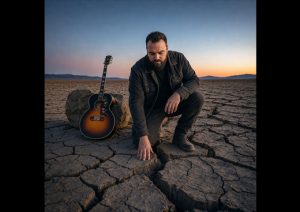
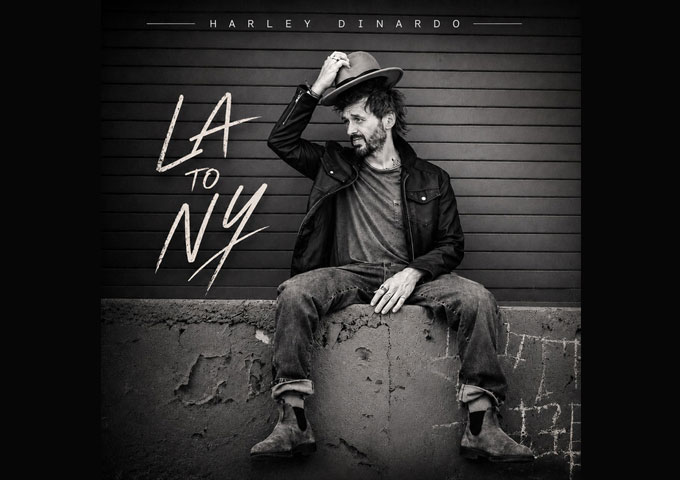
Harley DiNardo Turns Two Cities and a Lifetime of Memory Into “LA to NY”
Los Angeles and Woodstock become more than destinations. A roots-driven rock song about belonging in two places. Memory, family, loss, and reinvention shape the journey. Guitars and live instrumentation keep the sound defiantly organic. A new chapter emerges from a lifetime spent chasing songs.
Harley DiNardo has always understood that a life in music is rarely a straight road. It is a collection of detours, near misses, hard-earned victories, personal upheavals, and moments that permanently alter the meaning of everything that follows. On “LA to NY,” he turns that complicated journey into a rootsy rock & roll reflection on what it means to belong to two places while simultaneously carrying two versions of yourself.
The song draws directly from DiNardo’s experience of dividing his time between Los Angeles and Woodstock, New York. Yet reducing “LA to NY” to a geographical portrait would miss its deeper emotional architecture. These two locations represent different chapters, identities, memories, and possibilities. Los Angeles speaks to the life he has built over more than a decade, while New York remains inseparable from his upbringing, his musical beginnings, his family, and experiences that changed him forever.
Musically, Harley DiNardo reaches backward without sounding trapped in nostalgia. The track occupies a comfortable crossroads between the loose, swaggering roots rock of The Rolling Stones, the muscular Americana of The Black Crowes, the poetic road songs of Bob Dylan, and the melodic directness of Tom Petty. Those influences are recognizable in the song’s DNA, but DiNardo does not treat them as costumes. His approach feels grounded in the fundamental language of rock and roll: guitars that sound lived-in, real musicians responding to one another, melodic instincts that favor emotional clarity, and a groove that allows the story to breathe.
That organic quality is essential because “LA to NY” is ultimately a song about movement. Its physical journey between coasts becomes a metaphor for the internal journey of someone trying to reconcile where they came from with where they are now. Rather than turning the two cities into opposing forces, DiNardo allows them to coexist. One does not have to cancel out the other. Home can exist in more than one place, just as a person can contain more than one chapter of their own identity.
The songwriting becomes particularly affecting when the city imagery gives way to something much more personal. The line, “I was there when the skyline changed,” carries an enormous emotional burden precisely because DiNardo does not need to over-explain it. In the context of his life, those words reach far beyond conventional rock songwriting. On September 10, 2001, DiNardo had dinner with his mother and sister, Marisa, at the top of Tower One of the World Trade Center. The following morning, Marisa was killed in the September 11 attacks.
That history transforms the skyline from a simple image into a permanent dividing line in a life. The lyric is economical, but its emotional resonance is expansive. It suggests the instant when a familiar landscape became something else, while also acknowledging the strange persistence of memory. A skyline can change physically, but it can also remain frozen inside someone’s mind.
The decision to release “LA to NY” on September 10, one day before the 25th anniversary of the September 11 attacks, therefore gives the song an unusually charged context. It places the listener in a space between remembrance and continuation. The song is not presented as a memorial in the traditional sense, nor does it attempt to reduce decades of experience to one tragic event. Instead, the personal history sits beneath the music like an underground current, influencing how every reference to New York, distance, home, departure, and return is heard.
That restraint is one of the track’s strengths. DiNardo understands that grief does not always announce itself with dramatic declarations. Sometimes it exists in a place name, a remembered view, a family connection, or a sentence that seems straightforward until the listener discovers everything hidden behind it.
The broader lyric concept works in much the same way. The distance between Los Angeles and New York becomes a physical representation of emotional distance, but also of continuity. Traveling between the two means moving between past and present, memory and possibility, youth and experience. The song asks what happens when the person who left is no longer exactly the person who returns. The answer is not that one identity has to win. Instead, both remain part of the same individual.
That idea makes “LA to NY” particularly fitting for what DiNardo describes as his genuine second act. His musical history already contains several chapters that might have served as a conventional ending. As frontman of Closer, he emerged from New York’s rock scene and signed with Revolution Records/Warner Bros. Their debut album was produced by Ed Buller, whose production credits include work associated with The London Suede, Pulp, and White Lies, and the band went on to tour alongside artists including Peter Hook, Supergrass, Chumbawamba, Edwyn Collins, and Love Spit Love.
DiNardo later continued that trajectory with White Light Motorcade, whose album “Thank You, Goodnight” arrived through Octone/A&M and led to touring opportunities with The Donnas, Alice Cooper, OK Go, Ash, The Killers, and Rooney. The band also appeared at the Reading and Leeds Festival and participated in the MTV2/CMJ Advanced Warning Tour with The Mooney Suzuki, Longwave, and The Raveonettes.
That history matters because “LA to NY” does not sound like the work of someone discovering rock music for the first time. It sounds like an artist returning to something he knows intimately, but with a different understanding of what it means. Years of professional momentum, setbacks, personal losses, almosts, and reinvention have changed the perspective behind the songs.
The production reinforces that sense of authenticity. DiNardo produced “LA to NY” himself, with the final mix handled by renowned producer and engineer Niko Bolas and mastering completed by Steve Fallone at Sterling Sound. Michael Chambers contributes drums, adding to the live, human feel that keeps the track rooted in performance rather than polish for its own sake. An earlier mix by acclaimed producer Matt Wallace was also described by Wallace as “damn catchy,” underscoring the song’s immediate melodic appeal even as its subject matter reaches considerably deeper.
There is a refreshing refusal here to overcomplicate the music. The guitars do much of the emotional work, while the rhythm section gives the song forward motion. That simplicity is deceptive. Rootsy rock depends on the tension between familiarity and personality, and DiNardo uses that space effectively. The musical vocabulary may be classic, but the story belongs entirely to him.
His background also helps explain the song’s instinct for storytelling. Raised in Westchester, New York, and coming from a family of Italian folk singers, DiNardo was surrounded by performing arts from an early age. He wrote a film script at ten, joined a band at fourteen, and began writing and singing his own songs at eighteen. His relationship with Derrek Hawkins, whose career included work with artists such as Ace Frehley, Spacehog, and Stabbing Westward, became a major formative influence as DiNardo began establishing himself professionally.
Music and filmmaking have remained intertwined throughout his career. He continues to create both songs and films, with storytelling serving as the connective tissue between the two disciplines. His songwriting explores love, heartbreak, hope, family, loss, and resilience, while his filmmaking allows him to examine extraordinary moments hidden inside ordinary lives.
“LA to NY” consequently feels less like a nostalgic return than a statement of continuation. DiNardo is not trying to recreate the musician he once was. He is taking the accumulated experience of that earlier life and allowing it to inform what comes next.
The road between Los Angeles and New York becomes the perfect metaphor. One city represents the life that has been built; the other carries the indelible imprint of where that life began. Between them lies everything that cannot be neatly separated: family and ambition, grief and survival, memory and reinvention, the person one was and the person one becomes.
That is what gives “LA to NY” its staying power. Beneath the guitars and classic rock & roll instincts is a deeply human proposition: home is not necessarily a single destination, and moving forward does not require leaving the past behind. Sometimes the only way forward is to carry both.
For Harley DiNardo, this is what a second act sounds like. Not a retreat into yesterday, but a road song written from the middle of a life still unfolding.